Four walking routes through Thessaloniki, all from the same door in Ladadika. The Roman city, the waterfront out to the Concert Hall, the Upper Town walls, the market lanes. Each route carries its length, its walking time and what the ground does.
Four routes, one starting point
Thessaloniki is a walking city. The historic centre fits inside two kilometres, the ground rises only toward the north, and the monuments stand close together. What follows is four routes that all begin in Ladadika. Each one gives you its length, its walking time and the stops in the order you meet them.
The four routes
Measured from our entrance at 13 Ernestou Emprar. The times are walking only, with no stops.
Route
Length
Walking
Ground
The Roman and Byzantine city
2.2 km
28 min
Flat, with one rise at the start
The waterfront to the Concert Hall
5.4 km
Just over an hour
Flat the whole way
The walls and the Upper Town
2.8 km
35 min
Uphill from start to finish
The markets, a loop
2.0 km
25 min
Flat and crowded
Route 1
The Roman and Byzantine city
The route starts with a climb out of Ladadika toward the Roman Forum. The excavated square sits below street level, so you look down into it before you walk in. Its odeon went up in the second century AD as a small roofed theatre, on the ground of an older council chamber. Work to enlarge it into a proper theatre began in the middle of the fourth century and was never finished.
From there you drop down to Hagia Sophia. The building is seventh-century and the mosaics in its dome came two hundred years later. Egnatia then carries you east to the Kamara.
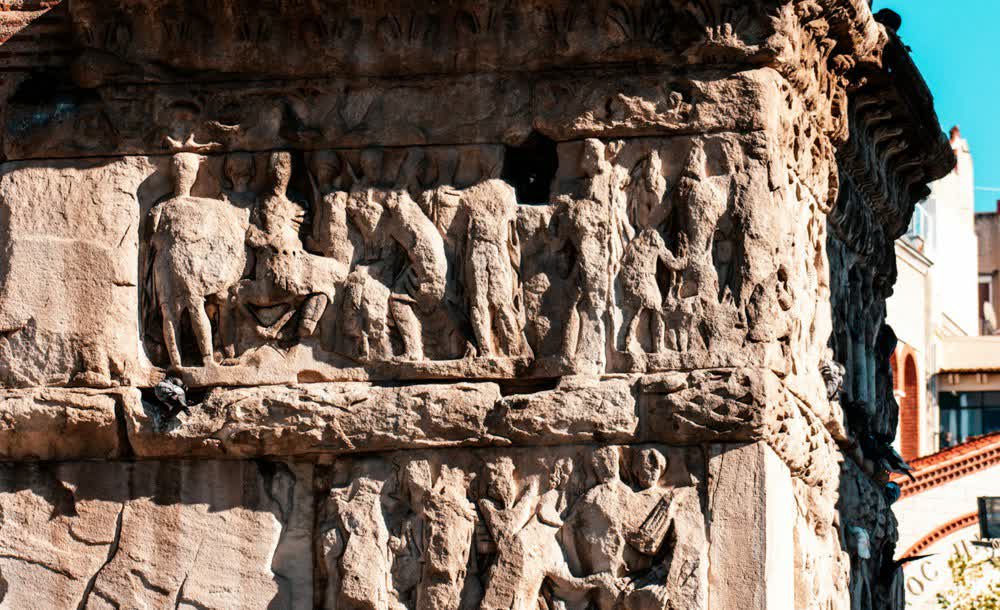
The Arch of Galerius went up in 305 AD, after the emperor's final victory over the Persians. It began as an eight-gated structure, four heavy central piers and four smaller ones at the sides. Two main piers and one lesser pier survive today, joined by a brick arch.
The axis that ran beneath it linked the palace to the south with the Rotunda to the north, and that axis is what you follow to the end. The Rotunda is a round building of the fourth century, raised as part of the same Galerian complex. It became a Christian church, later a mosque, and its minaret still stands beside it.
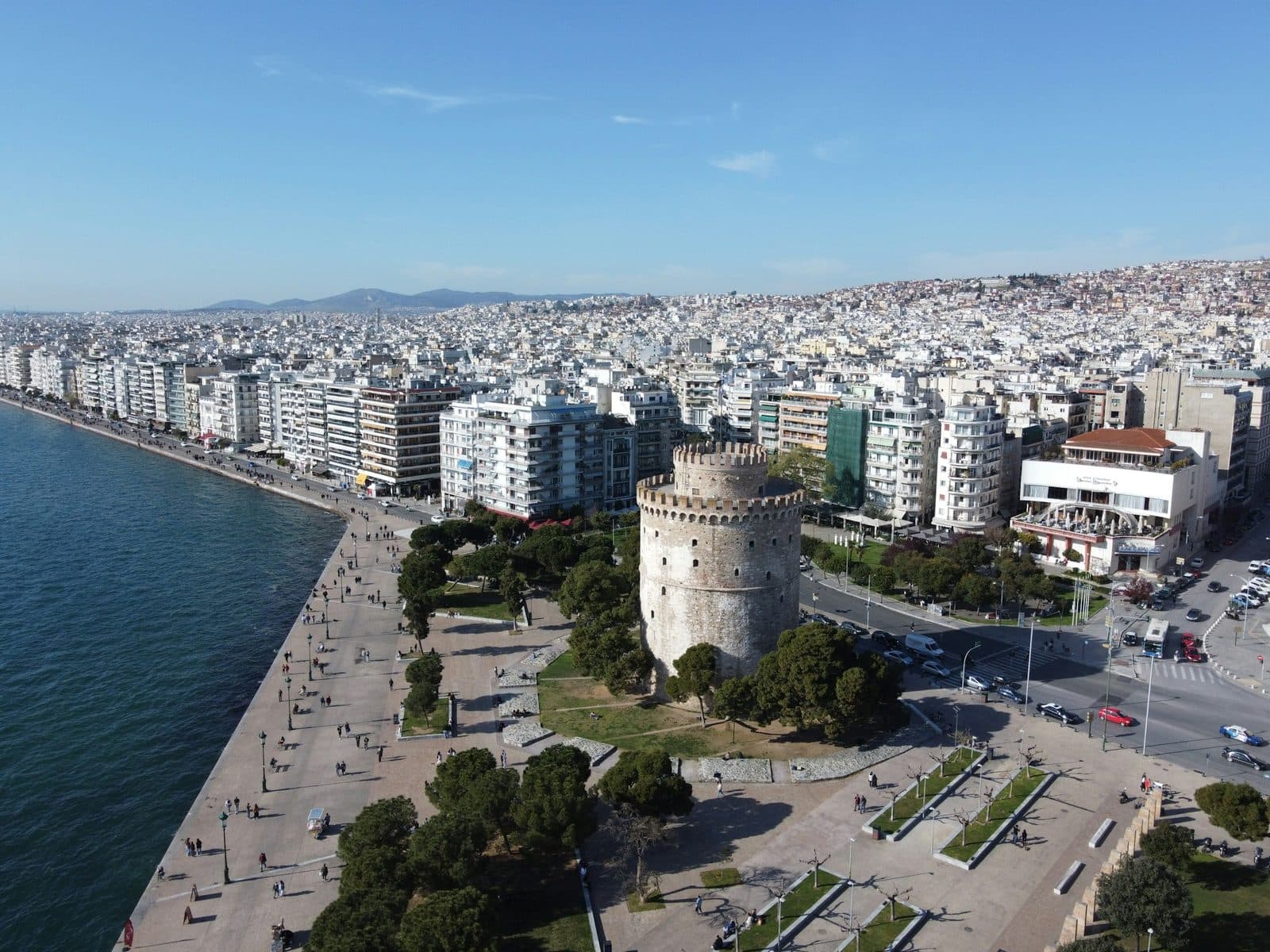
The port is next door to us, and from there you follow the sea east. The White Tower marks the point where the old quay ends and Nea Paralia begins.
From there to the Concert Hall the paving runs 3.5 kilometres without a turn. Thematic gardens open along the inland side, among them the Garden of Alexander with its equestrian monument, the Garden of the Afternoon Sun with Zongolopoulos's Umbrellas and, at the far end, the Garden of Music.
The route never climbs. Shade is thin, so in summer the walk belongs to the late afternoon. Once the sun drops, half the city is out here.
White Tower, where Nea Paralia begins
Garden of Alexander, the equestrian monument
Garden of the Afternoon Sun, Zongolopoulos's Umbrellas
Concert Hall, the Garden of Music and the end of the walk
This one climbs from the first turn to the last. You start again at the Roman Forum, pass Agios Dimitrios and enter the cobbled lanes of Ano Poli.
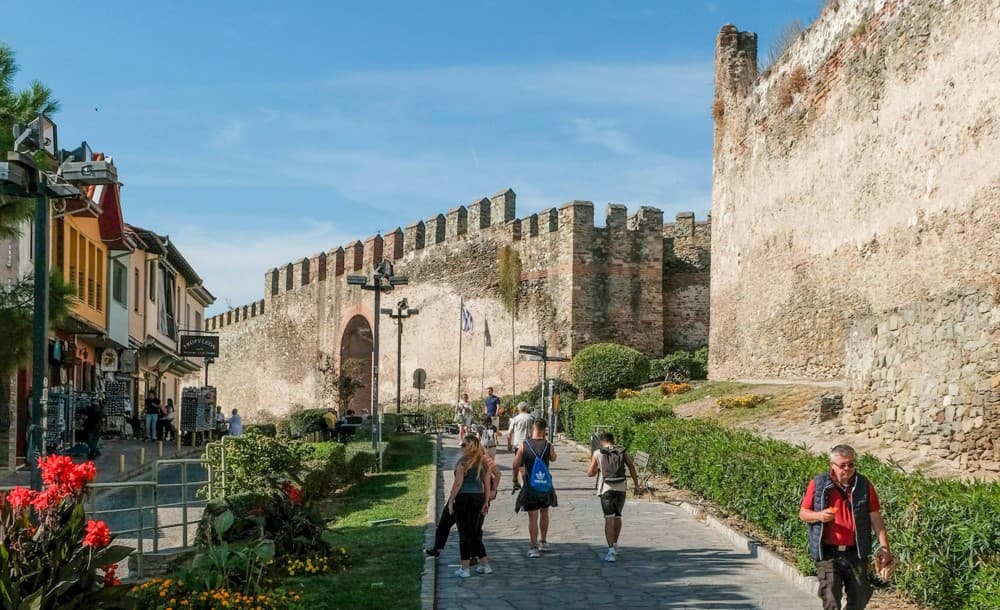
Higher up the road meets the walls and follows them. Stone and brick in alternating bands, towers at intervals, houses built straight onto them. At the Trigoniou Tower the whole city opens out to the gulf, and that is where most people stop.
The Heptapyrgion is the end. It is a closed polygonal fortress of ten towers, triangular and quadrilateral, although its name says seven. A marble inscription of 1431 is set into the main entrance and names the city's first Ottoman governor. From the 1890s it served as a prison for roughly a century, until 1989, when it passed to the Ministry of Culture.
We will say it plainly. The climb is hard work, and plenty of people ride up by taxi and walk back down.
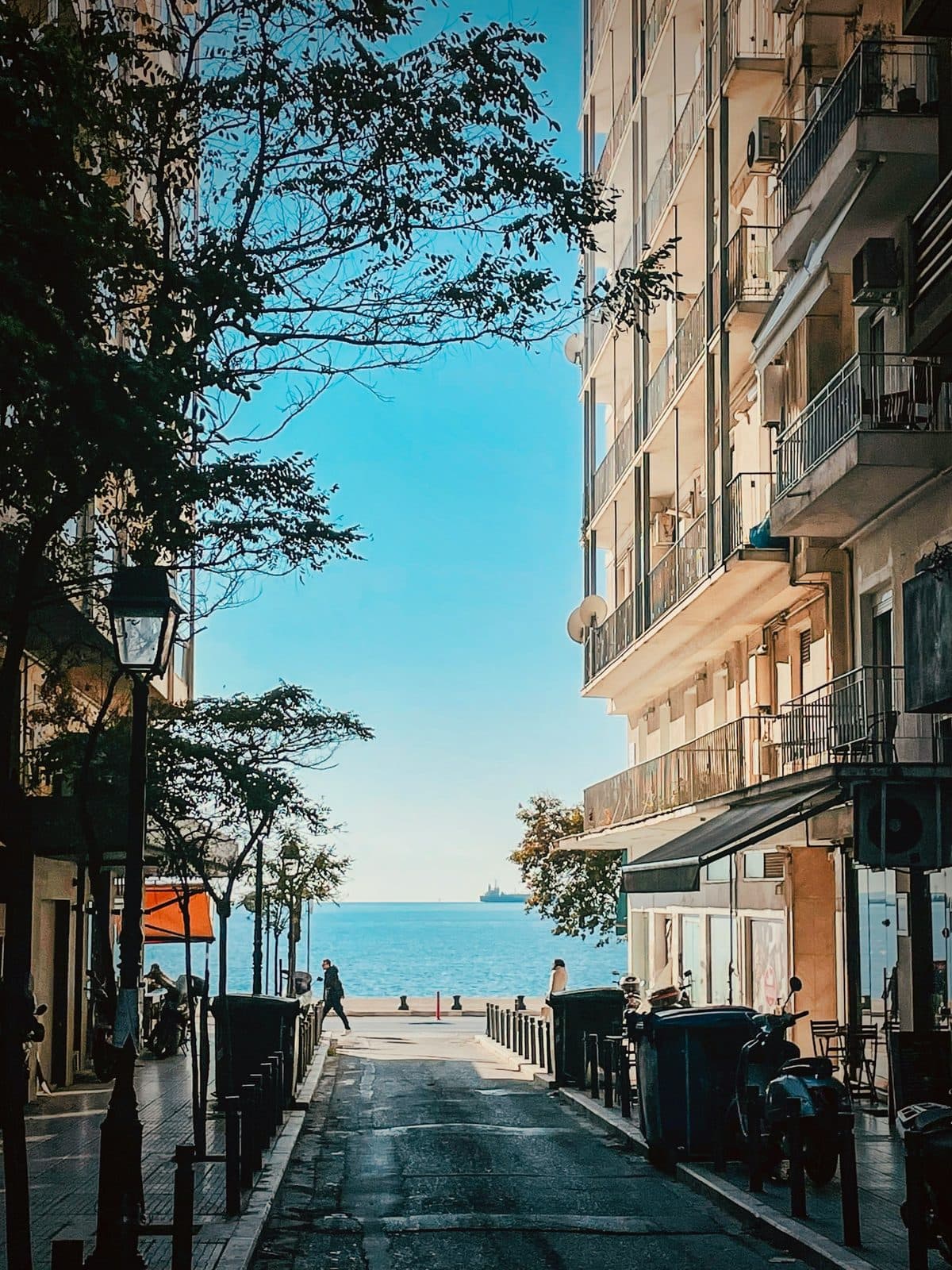
The fourth walk is the shortest and the densest. You leave Ladadika, cross Tsimiski and step straight into the market lanes. The covered Modiano hall stands in the middle of them, under its iron and glass roof.
Kapani, also called the Vlali market, has traded for more than two centuries and was never built for visitors. It is a run of pedestrian streets full of stalls, Menexe, Vlali, Solomou and Chalkeon, with kafeneia and mezedopoleia wedged between them. Come in the morning, because that is when it works.
Two Ottoman buildings stand at the corner of Egnatia and Venizelou. The Bezesten was the covered hall of the cloth merchants and the goldsmiths. Beside it the Hamza Bey mosque, known as the Alkazar, dates from the fifteenth century.
A little further on, Athonos market works for its own neighbourhood and the Bit Bazaar arcade keeps its junk dealers and small cafés.
The cobbles in Ano Poli and Ladadika turn slippery in rain, so your shoes matter more than your plan. In July and August the middle of the day is the worst time to climb anything. Carry water and a hat.
All four routes leave from the same door, and that is the argument for a base in the centre. You come back, shower, change and go out again. Each suite has a full kitchen and a washing machine, so the clothes you walked in do not follow you through the rest of the trip.
Which walk should I pick if I only have one afternoon?
The waterfront, if you would sooner not think about it. It stays flat the whole way and needs no map, because the sea is always on your right. If you want monuments instead, the Roman and Byzantine route is the shortest of the four.
How hard is the climb to Ano Poli?
It goes uphill the entire way, and in July or August that counts. Plenty of people ride up by taxi and walk back down, which is far easier on the knees. On foot, start early in the morning or late in the afternoon.
Do I need a ticket for any of these walks?
Not for the walking. The streets, the promenade and the market lanes are all free to use. Monuments and archaeological sites each have their own entry rules, and those change, so look them up before you go.