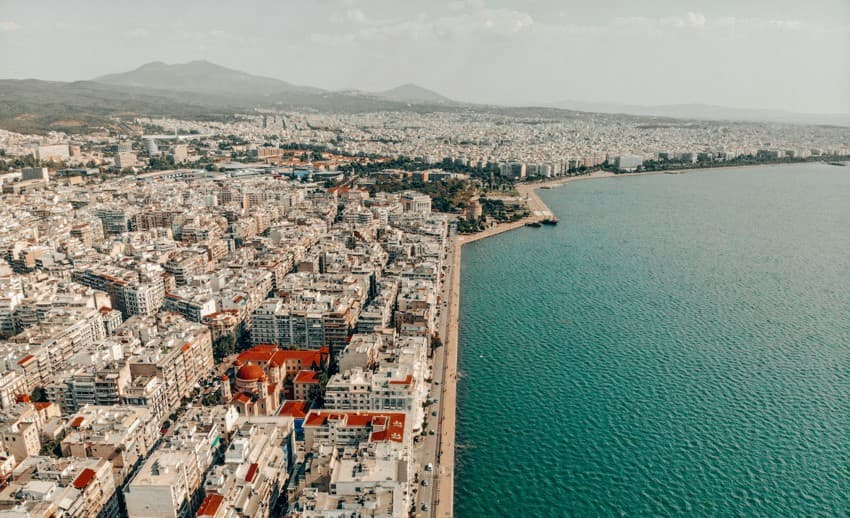
The Roman axis and the Byzantine UNESCO monuments of Thessaloniki, with the walk from Ladadika to each one. Plus the Olympou quarter around them, its patisseries, meze rooms and record shops.
The axis of Galerius
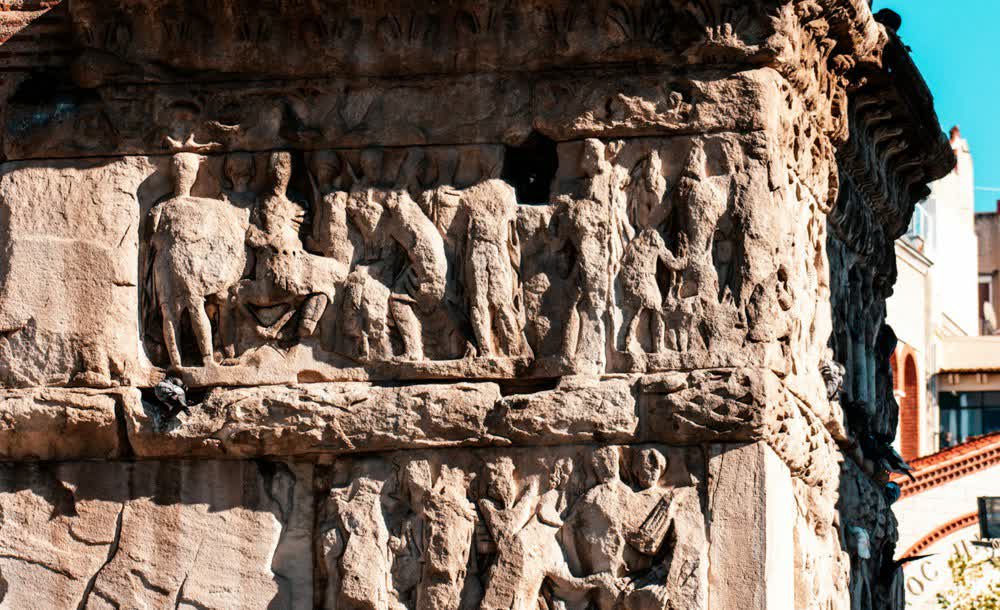
Galerius laid his Thessaloniki out along a single line. The palace to the south, the triumphal arch in the middle, the Rotunda to the north. The arch, the Kamara that the city meets under, went up in 305 AD after the emperor's final victory over the Persians, and its reliefs tell that campaign in bands. It began as an eight-gated structure. Two main piers and one lesser pier survive, joined by a brick arch. The Rotunda, on Plateia Agiou Georgiou, was raised as part of the same complex in the fourth century, became a church, then a mosque, and its minaret is the only one left standing in the city.
Galerius's campaign, cut into the pier in bands.
The Forum below street level
The Roman Forum is excavated lower than the modern city, so you look down into it before you walk in. Its odeon went up in the second century AD as a small roofed theatre, on the ground of an older council chamber. Work to enlarge it began in the middle of the fourth century and was abandoned. In summer the odeon holds performances. From the street you can see the whole site for nothing.
The UNESCO monuments, on foot
Thessaloniki carries fifteen Early Christian and Byzantine monuments on the UNESCO list. Five of the most important stand in this one strip. The Roman Forum is 11 minutes from our door, Agia Sofia 14, Agios Dimitrios 16 with a rise at the end, the Arch of Galerius 20 and the Rotunda 21. Agia Sofia is a seventh-century building whose dome mosaics came two hundred years later. Agios Dimitrios is the basilica of the city's patron, and the crypt of his martyrdom opens underneath it.
Olympou runs between the monuments, and the quarter eats along it. Tsarouchas at number 78 has served patsas since 1952, with its pot lit without a break since 1967. Further down opens the Bit Bazaar, a square of antique stalls by day and meze rooms after dark. Diagonios has kept white tablecloths since May 1977. Mourga, on Christopoulou, brought the city its modern fish-meze room and the natural wine list everybody copied afterwards. Sun Do Each bakes to order on Plateia Ippodromiou.
Two patisseries here have run for over a century. Chatzis on Pavlou Mela has made kazan dipi and ekmek with buffalo-milk kaimaki since 1908, and Konstantinidis has made its glyka Beirut since 1925. For bougatsa, Bantis has pulled phyllo by hand since 1969 and still serves the plain version nobody else keeps. Coffee belongs to Sortie, which roasts in house and puts a terrace in front of the Rotunda. Vinyl splits across two addresses, Lotos behind Agia Sofia and Pikap on Olympou, which runs a bar, a record shop and a radio station out of one room.
Prigkipessa on Filikis Etairias is the one true rebetadiko in the centre, live players, no microphones, no dance floor, going since 2006. The Hoppy Pub on Nikiforou Foka keeps eighteen taps and pours nothing industrial. Ennea, on the ninth floor of the MonAsty, opens a 360-degree view over all of it.
A record shop behind Agia Sofia, Skra 7 — vinyl and CDs, imports and Greek independent labels.
Since December 1990
“Amazing location and a spotless apartment!”
Foteini, July 2025
Frequently asked questions
Which UNESCO monuments are near Ladadika?
The Roman Forum is 11 minutes on foot, Agia Sofia 14, Agios Dimitrios 16, the Arch of Galerius 20 and the Rotunda 21. The city holds fifteen monuments on the list altogether.
Where is the Rotunda?
On Plateia Agiou Georgiou, a short way above the Kamara, on the same line as the arch and the palace. From our door it is 21 minutes on foot.
Do you need a ticket for all of them?
No. The Roman Forum can be seen from the street for nothing, and the churches are working places of worship, so the usual courtesies apply. The monuments run as museums have their own tickets and their own hours.
Where do people eat around here?
On Olympou, Tsarouchas has served patsas since 1952 and the Bit Bazaar fills with meze rooms at night. Closer to the Kamara, Diagonios has kept its soutzoukakia since 1977 and Mourga its natural wine. For something sweet, Chatzis and Konstantinidis have each been open over a hundred years.