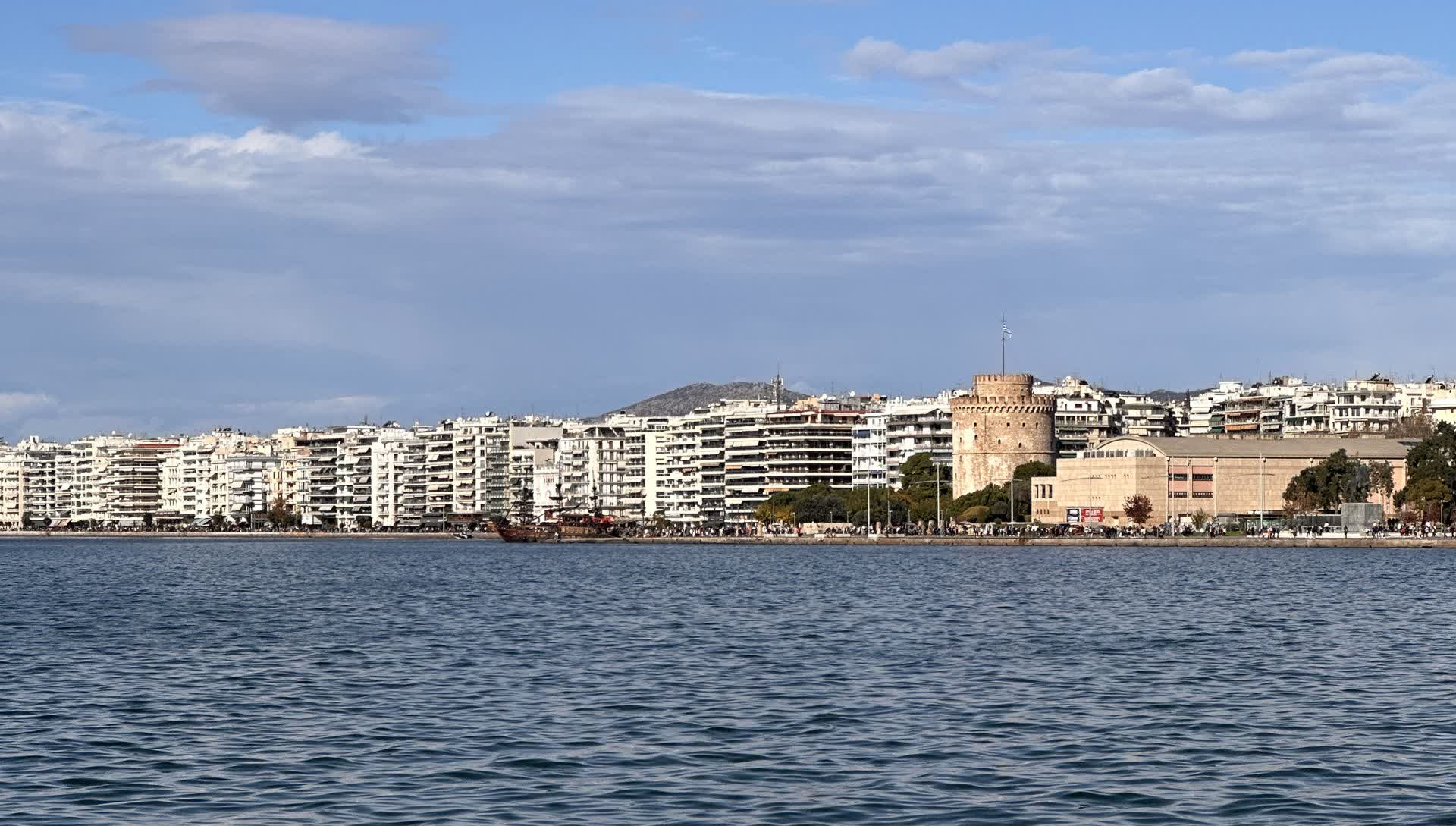
The city's emblem, and the museum of its own history.
The White Tower: a fifteenth-century Ottoman tower, for centuries a prison, now a six-floor museum of the city's own history. What is inside, and the walk from Ladadika.
What it is
The White Tower stands at the southeast corner of the old sea walls, where the waterfront met the fortification. The Ottomans built it in the second half of the fifteenth century on the site of an earlier Byzantine tower, and for centuries it was one link in a continuous wall rather than the free-standing monument you see today. The walls around it came down in the 1870s, when the city opened itself to the sea, and the tower was left alone.
Why it is white
The building was a prison, and in the nineteenth century it was known as Kanli Kule, the Tower of Blood, for the executions carried out there. In 1890 it was whitewashed and took the name it still carries. The story told in the city is that a prisoner did the painting in exchange for his freedom. Good story, no documentation. What is documented is the whitewashing and the change of name.
What is inside
The tower has six floors and a spiral ramp that climbs them in a circle around the central core. Each floor holds a section of the permanent exhibition on the history of Thessaloniki, from the Roman city to the twentieth century, and it runs as an annex of the Museum of Byzantine Culture. At the top you come out onto the roof: the Thermaic Gulf in front of you and, on a clear day, Mount Olympus across the water.
The dimensions
The tower stands about 34 metres high and about 23 across, with walls thick enough for the ramp and the rooms to be cut inside them. From outside it reads as solid and heavy, which was the job: it was defensive work, not decoration. The low outer wall ringing its base is a later addition.
What is around it
The tower marks the point where the old waterfront becomes Nea Paralia. East of it runs the promenade with its gardens, its sculptures and Zongolopoulos's Umbrellas; west, the road curves back toward Aristotelous and the port. The equestrian Alexander the Great stands beside it. If you have walked this far, the natural thing is to keep going east with the sea beside you.
The walk from our door
From 13 Ernestou Emprar you drop down to the waterfront and follow it the whole way with the sea on your right. It is a single straight line, no hills and no major road to cross. The same walk takes you past the port, Aristotelous and the start of Nea Paralia, so few people do it without stopping.
At a glance
From our door: 23 minutes on foot.
In the historic centre, walkable from Ladadika.
What else is close
Thessaloniki's monuments sit close together, and most of the distances are measured in minutes. The times below are from our door.
Yes, for the view and for the climb itself. The ramp spirals rather than stepping, so you go up gradually. From the top you see the whole bay, and it becomes obvious why the city was built where it was.
How long does a visit take?
Allow about an hour for the exhibition and the roof without rushing. Combine it with the walk along Nea Paralia and it becomes an afternoon.
Is the White Tower the Museum of Byzantine Culture?
No, they are two different buildings. The tower operates as an annex of the museum and its exhibition covers the city's history. The Museum of Byzantine Culture itself is a separate building a little further east.