The fifteen Paleochristian and Byzantine monuments of Thessaloniki on the UNESCO World Heritage List. Acheiropoietos, Osios David, Panagia Chalkeon, Agios Nikolaos Orphanos, the city walls. What to look for and where each one stands.
What UNESCO actually listed
In 1988 UNESCO inscribed fifteen monuments in Thessaloniki on the World Heritage List as one property, the Paleochristian and Byzantine Monuments of Thessalonika. They cover a thousand years of building, from the Roman Rotunda at one end to the late Byzantine churches of the Upper Town at the other. Some of them are not churches. The city walls go on the list whole, and so does one small public bath. The three best known, Agios Dimitrios, Hagia Sophia and the Rotunda, have their own pages here, so what follows gives its weight to the rest, the ones most visitors never reach.
The list is the one the Municipality of Thessaloniki publishes with the archaeological service.
Monument
Where it is
What to look for
The city walls
West centre and Ano Poli
Eight kilometres of fortification, with the repair inscriptions still on the stone
The Rotunda
Centre, above the Kamara
The dome mosaics and the only minaret left standing in the city
Osios David (Latomou Monastery)
Ano Poli
The mosaic of Ezekiel's vision, in the apse of the sanctuary
Agios Dimitrios and the crypt
Centre
The mosaics that survived the fire, and the crypt under the floor
Panagia Acheiropoietos
Centre, beside Egnatia
Mosaics on the undersides of the arches, above the colonnades
Hagia Sophia
Centre
The Ascension in the dome and the iconoclastic cross behind the Virgin
Panagia Chalkeon
Centre, near Kapani market
Walls built entirely of brick, and the founder's tomb inside the north wall
The Byzantine bath
Ano Poli, Theotokopoulou Street
The one secular building on the list, warm room and hot room intact
Agios Panteleimon
Centre, near the Kamara
The ambulatory wrapped around the cross-in-square core
Agioi Apostoloi
Centre, by the western walls
Ceramic brickwork decoration, best on the eastern face
Agios Nikolaos Orphanos
Ano Poli
The most complete set of wall paintings left in Thessaloniki
Agia Aikaterini
Ano Poli, near the north-west walls
Five domes and a closed ambulatory ending in two chapels
Metamorphosis tou Sotiros (the Transfiguration)
Centre, on Egnatia
A small four-apsed church with paintings in the Palaeologan manner
Vlatadon Monastery
Ano Poli, outside the Acropolis walls
The only Byzantine monastery in the city that still works
Profitis Ilias
Ano Poli, on Olympiados
The Athonite plan, built here and nowhere else in the city
Acheiropoietos, the basilica everyone walks past
Acheiropoietos stands in the middle of the modern centre, a few steps off Egnatia, and most visitors go by without going in. It is a three-aisled wooden-roofed basilica with a narthex and an upper gallery, raised in the middle of the fifth century over a Roman bath complex, and it is the most important early Christian basilica still standing in Greece. Its name turns up first in a document of 1320 and refers to an icon of the Virgin the church once held. Inside, look up. The mosaics are on the undersides of the arches above the colonnades, where a visitor rarely thinks to look, and they carry plants, birds, geometric patterns and Christian symbols worked close enough to read.
Osios David, and one mosaic worth the climb
At the dead end of a lane in Ano Poli stands a church small enough to walk straight past. It was the catholicon of the monastery of Christ the Saviour of Latomos, and the name comes from the stone quarries that once worked the slope. It went up at the end of the fifth century. In the apse of the sanctuary is a mosaic of the prophet Ezekiel's vision. Christ sits young and beardless on a rainbow, the symbols of the four evangelists around him, four rivers running out beneath. Early Christian art left very little of this quality anywhere. After the conquest of 1430 the building became a mosque, and it came back to Christian worship only at the start of the last century.
The Red Church, in the coppersmiths' quarter
Panagia Chalkeon takes its name from the copper workshops of the surrounding streets. They are still there. A marble inscription over the west door gives the year 1028 and the names of Christophoros, protospatharios and governor of Lagouvardia, his wife Maria and their three children. The founder's tomb sits in an arcosolium cut into the thickness of the north wall. The whole building is brick, with no stone in the facades, and the city has long called it the Red Church. Blind arches, recessed niches and half-columns break up the elevations the way they do on the monuments of Constantinople.
Higher up, in Ano Poli
Four of the fifteen sit above Olympiados Street, in the lanes of the Upper Town. The climb is real. Agios Nikolaos Orphanos, inside a walled yard near the eastern walls, holds the most complete set of wall paintings left in Thessaloniki, put on around 1310 to 1320. Agia Aikaterini, from the turn of the fourteenth century, carries five domes and a closed ambulatory that ends in two matching chapels. Profitis Ilias sits on a rock outcrop above the street and is the only church in the city built to the Athonite plan, which until then had never been used outside Mount Athos. Highest of all, just beyond the Acropolis walls, Vlatadon is the one Byzantine monastery in Thessaloniki still working, founded somewhere between 1351 and 1371.
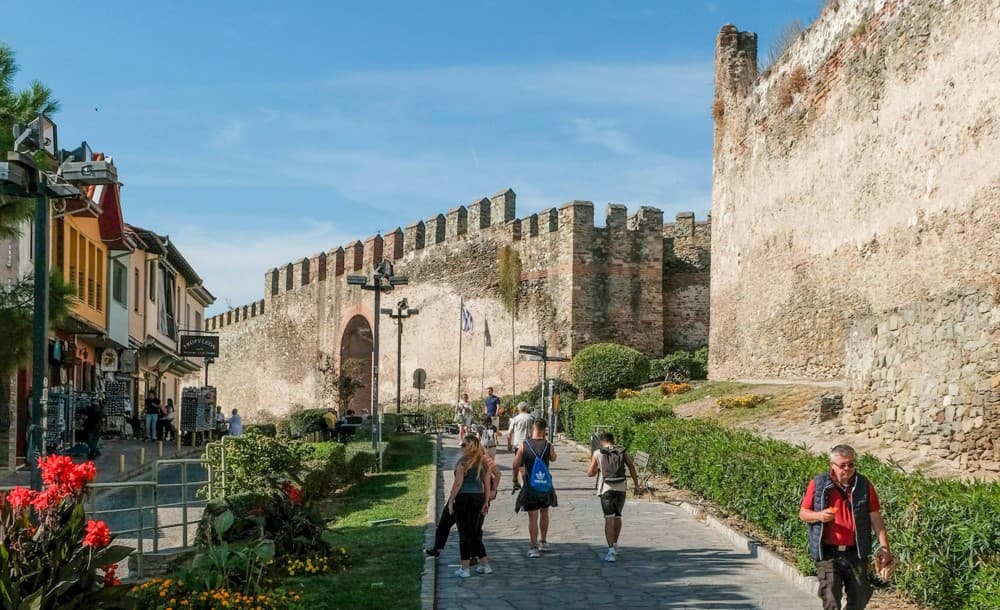
Two of the fifteen have nothing to do with worship. The city walls go on the list whole. That is eight kilometres of fortification raised at the end of the fourth century, in the reign of Theodosius, on top of Hellenistic and Roman remains. Triangular bastions alternated with square towers across the flat ground, while a lower sea wall guarded the city from the water, and the inscriptions still on the stone record the repairs one after another. The second is a bath. On Theotokopoulou Street, at the edge of Ano Poli, stands the only public Byzantine bath left in the city, small and rectangular, with its antechamber, its warm room, its hot room and its cistern all in place.
The parish churches open in the morning and again in the early evening, around the services.
Shorts and sleeveless tops are turned away at the door. These are working churches.
The city-centre monuments are an easy walk. Ano Poli is a climb, so allow for it.
Where you stay
Our suites are in Ladadika, inside the historic centre. Hagia Sophia is 14 minutes on foot from our door. Agios Dimitrios is 16 minutes, with the hill saved for the end. Beyond that, a short taxi takes the steepest part of the Upper Town off your legs and drops you at the top of the lanes.
How many Thessaloniki monuments are on the UNESCO list?
Fifteen, inscribed in 1988 as one property called the Paleochristian and Byzantine Monuments of Thessalonika. Some of them are not churches. The city walls are on the list, and so is a small Byzantine bath in the Upper Town.
Do the Byzantine churches charge for entry?
No, entry is free at every church on the list. Shorts and sleeveless tops are turned away, though, because most of these are working parish churches and not museums.
When are they open?
Parish churches open in the morning and again in the early evening, around the services. Osios David and Agios Nikolaos Orphanos run as visitable monuments instead, on shorter hours with one closing day a week. Official sources disagree about which day that is, so ask us before you make the climb.
Which churches fit into one morning?
Three sit close together in the centre, within a few minutes of each other on foot: Acheiropoietos, Hagia Sophia, and Agios Dimitrios with its crypt. If a fourth fits, Panagia Chalkeon is beside Kapani market. Ano Poli deserves an afternoon of its own.