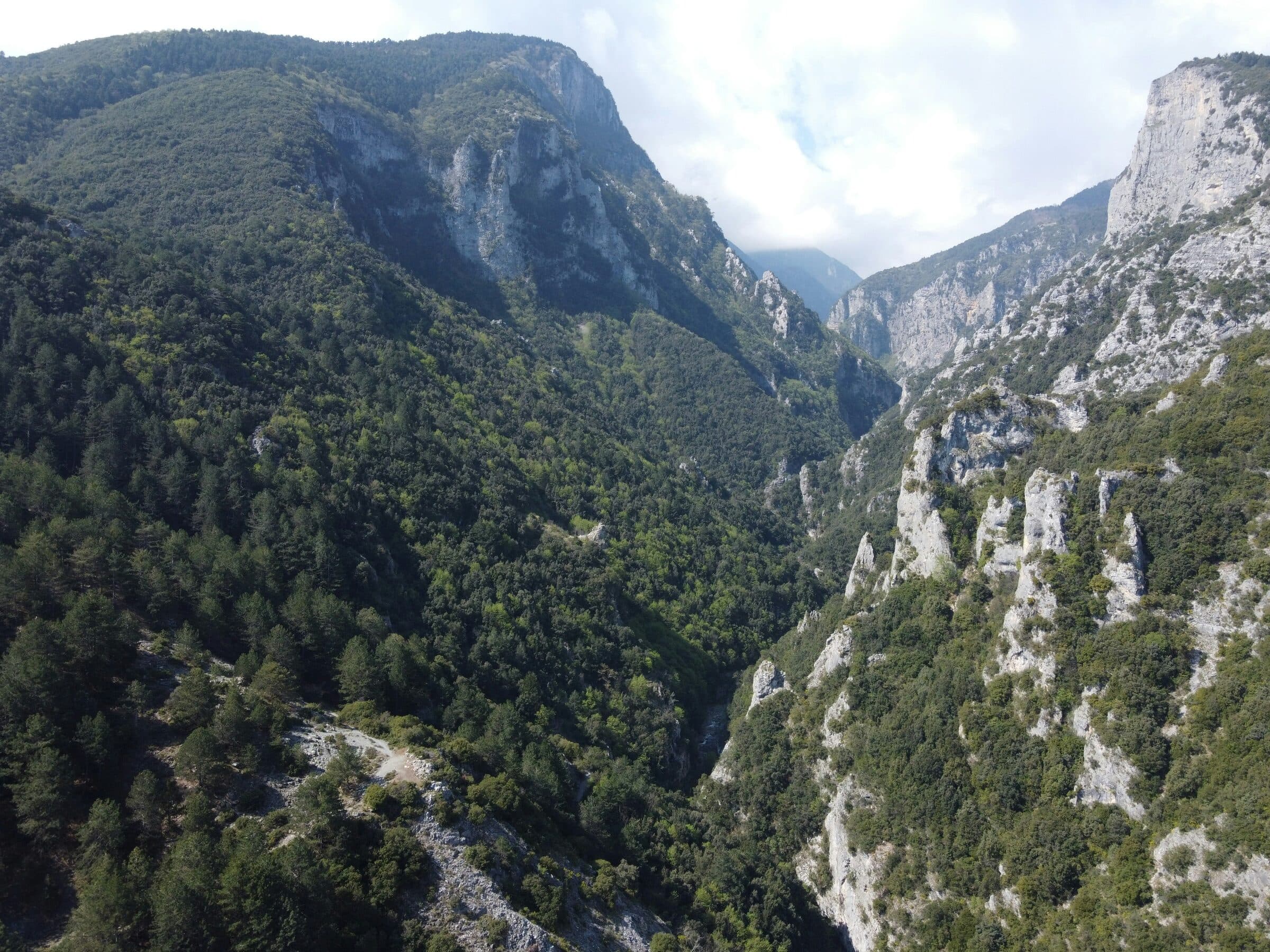
From Thessaloniki, Mount Olympus works as a single day, as long as you pick the right part of it. Litochoro, the Enipeas gorge, Prionia and the low trails all fit, and you are back for dinner. The summit does not fit. The municipality of Dion-Olympos puts Prionia to the Spilios Agapitos refuge at about three hours of climbing, and the refuge to Mytikas at another three, with the last stretch a scramble over the rock steps known as Kaki Skala. The refuge exists because that ascent takes two days.
Walking times come from the Dion-Olympos municipal route sheets and assume no stops. On the road, traffic decides.
Leg
How
How long
Thessaloniki → Litochoro
Car, A1 motorway south
~90 km
Thessaloniki → Katerini
KTEL Pierias, Makedonia terminal
50 minutes
Katerini → Litochoro
KTEL Pierias
25 minutes
Litochoro → Prionia
Car, climbing mountain road
18 km
Prionia → old monastery of Agios Dionysios
Walk, easy
6 km, ~2 hours
Litochoro → Prionia through the gorge
Walk, moderate
12.4 km, ~6 hours
Prionia → Spilios Agapitos refuge
Walk, moderate
6.1 km, ~3 hours
Getting to Litochoro
By car it is straightforward. You take the A1 south for about ninety kilometres and come off at the Litochoro exit, around an hour and a quarter from the centre on a clear road, closer to an hour and a half when the city exit is busy. Without a car, KTEL Pierias runs from the Makedonia terminal to Katerini in fifty minutes, and Katerini to Litochoro in another twenty-five. There is a railway station too, though it sits five kilometres outside the town and leaves you a taxi for the last stretch.
Litochoro sits on the eastern slopes of Olympus and has been the classic starting point for the mountain for as long as people have climbed it. The town was founded in the fourteenth century, and stone mansions in the Macedonian style still stand along its lanes. Its history is odder than the setting suggests. Most of the men who lived here went to sea, and the town's maritime museum holds around a thousand objects from that trade. The KTEL stops in the centre and the taxi rank is on the main square, so a day here works without boots. Coffee on the square, a walk through the old lanes, lunch with the sea below you.
The Enipeas gorge
The best hours of the day are inside the gorge. The path starts at the Mylloi spot above Litochoro at 400 metres, belongs to the European E4, and climbs to Prionia at 1,100. The municipality records it as 12.4 kilometres and six hours, with a great deal of up and down in the middle. Most people do it the other way round, driving to Prionia and walking down towards the town. For a short version, take the six kilometres from Prionia to the Holy Cave and the old monastery of Agios Dionysios, rated easy at about two hours, with the Enipeas waterfalls a few minutes below. The monastery in the gorge receives pilgrims from April to October, and the Enipeas is the one river on Olympus that carries water all year.
Prionia, and the road that climbs to it
Prionia is where the road ends and the trails begin, at 1,100 metres. From Litochoro it is eighteen kilometres of climbing bends, asphalted since 2018, with a car park and a restaurant that works through the year at the top. Do not budget the time as though those eighteen kilometres were flat. The road closes. In January 2026 the municipality shut it beyond Gortsia after a rockfall and reopened it in February, and snow brings its own restrictions. In summer, when fire risk climbs, the Regional Unit of Pieria bans movement in parts of the national park. Ask in Litochoro before you drive up.
A national park since 1938, World Heritage since 2026
Olympus was the first place in Greece to be protected as a national forest, by royal decree in 1938. UNESCO added it to the Man and the Biosphere reserve network in 1981, and a presidential decree in 2021 widened the protected area and set out its zones as a national park. Then in July 2026, at its 48th session in Busan, the World Heritage Committee inscribed the wider area of Olympus on the World Heritage List as a mixed cultural and natural property, by unanimous vote. It is Greece's third mixed property after Meteora and Mount Athos. Mytikas, the high point, stands at 2,918 metres. The park is managed by NECCA, whose unit and information centre sit in Litochoro itself.
Back in the city by evening
A day out works better when the base stays put. You leave Ladadika in the morning and come back to the same suite at night, with no second check-in and no repacking. The bags stay where they are. Our five suites each have a full kitchen, so breakfast before an early start happens upstairs, and the partner garage about 250 m from the entrance keeps a hire car close, open around the clock and charged separately.
Can I climb Mount Olympus in a day from Thessaloniki?
No, and it would be unsafe to try. Even if you drive up to Prionia, the Spilios Agapitos refuge at 2,100 metres is about three hours above it, and Mytikas another three, with the final stretch a scramble across Kaki Skala. Add the descent and the road from Thessaloniki and the day runs out. People climb it by sleeping at the refuge, and the route wants mountain experience.
Do I need a car for Mount Olympus?
For Litochoro, no. KTEL Pierias runs from the Makedonia terminal in Thessaloniki to Katerini in fifty minutes, and Katerini to Litochoro in another twenty-five. Prionia is different. The eighteen-kilometre road up from Litochoro has no regular public service, so you want a car or a taxi from the town.
When is the best time to go?
Late spring through October, while the mountain is open and the water is full. The Spilios Agapitos refuge runs from May to October, and the monastery in the gorge receives pilgrims from April to October. Winter can close the Prionia road altogether. In high summer the Regional Unit of Pieria bans movement in parts of the national park when fire risk is very high, so check before you set out.
Is the Enipeas gorge walk hard?
The municipality rates it moderate and calls it tiring, because the path keeps rising and dropping across 12.4 kilometres and six hours from Litochoro up to Prionia. Downhill from Prionia to the town is much gentler. The short option, Prionia to the Holy Cave and the old monastery, is six kilometres and about two hours, and it is rated easy.