A local food guide to Thessaloniki, Greece's gastronomy capital: meze and tsipouro, the Modiano and Kapani markets, bougatsa and street food, trigona and sweets, coffee culture, and where to base yourself in Ladadika.
Why Thessaloniki is Greece's food capital
Thessaloniki is widely called the gastronomy capital of Greece, and the claim holds up the moment you sit down. Centuries as a crossroads port left a kitchen that draws on Anatolia, the Balkans, and the wider Aegean, refined by waves of refugees who reshaped the city in the early twentieth century. The result is a city that eats slowly and seriously: long tables of shared plates, an obsession with fresh seafood off the gulf, and pastries that locals queue for at dawn. Eating here is less a series of meals than a continuous, unhurried activity that runs from morning bougatsa to a midnight last plate.
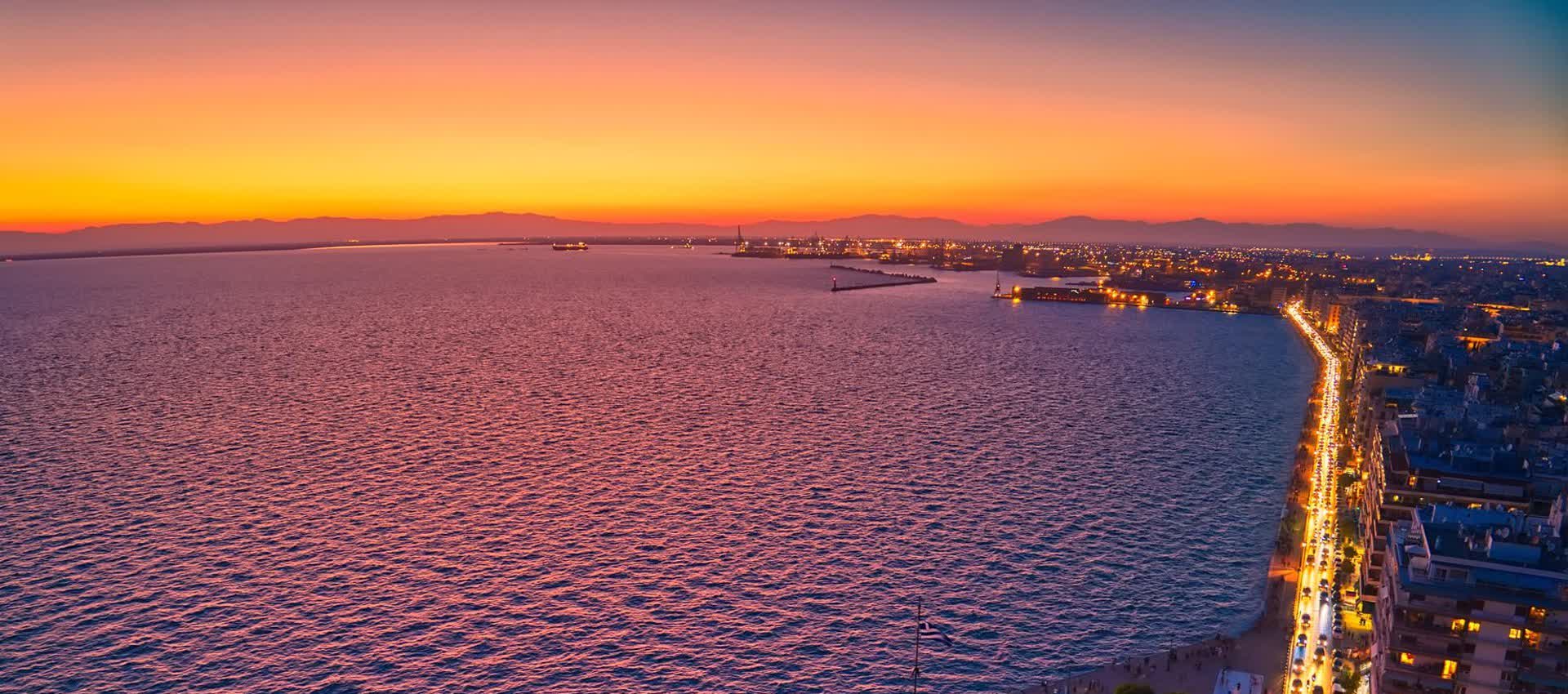
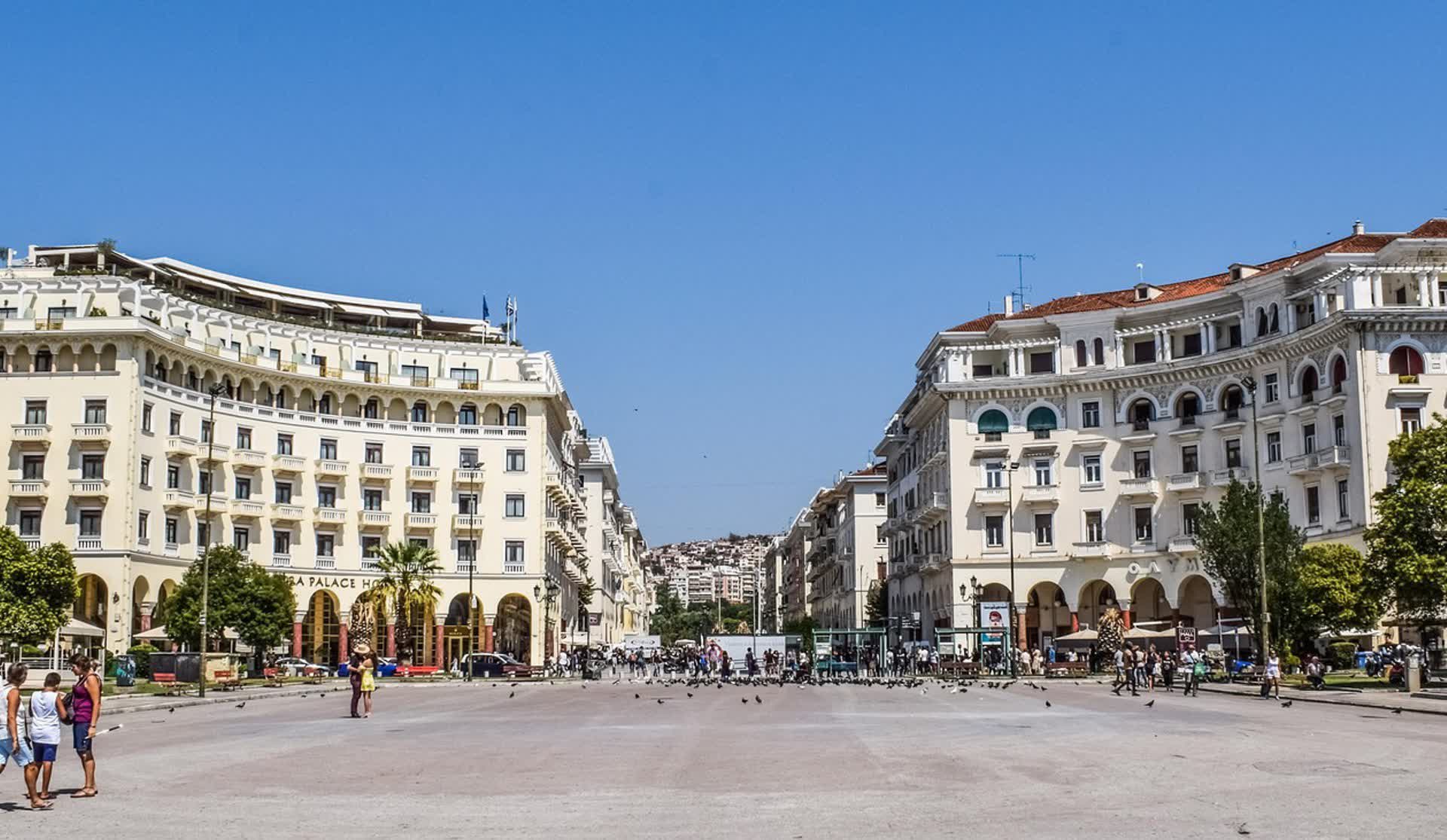
The Aristotelous axis from above, running down to the seafront.
The one big dinner
Where the city goes to celebrate
If you book a single special table, make it Charoupi — chef Manolis Papoutsakis's daring Cretan cooking, two FNL stars, and barely three minutes from our door in Ladadika. For something more storied, Olympos Naoussa revives a 1920s legend inside a 1926 mansion on the seafront. And Mourga, a tiny room near the Roman Agora, is the one the critics and the natural-wine crowd name first. None of the three is the city's loudest address; all three are the ones Thessalonians are quietly proud of.
Charoupi — Cretan, two FNL stars, 3 min from Ladadika
Olympos Naoussa — a 1920s legend reborn, on the seafront
Mourga — the chef-driven, natural-wine room locals love
Fish off the gulf
Seafood, the way the north does it
Thessaloniki takes its fish seriously. The benchmark is Mavri Thalassa, a family fish house serving since 1926, out on the Kalamaria seafront — a short taxi rather than a walk, and worth the ride. Closer to home, Trizoni Exclusive holds the same two FNL stars a couple of minutes away, grilling wild Greek fish over oak charcoal beside us in Ladadika, while 7 Thalasses is the central fish house everyone has been to, a few minutes from Aristotelous.
Mavri Thalassa — the benchmark, since 1926 (a short taxi)
Trizoni Exclusive — two FNL stars, minutes away in Ladadika
7 Thalasses — the central classic, near Aristotelous
Meze and tsipouro: how to eat like a local
The heart of Thessaloniki dining is the meze table. You do not order a single main; you order in rounds of small plates that arrive slowly while a bottle of tsipouro or ouzo sits open between you. Grilled octopus, mussels saganaki, marinated anchovies, soutzoukakia, fava, and stuffed peppers are the staples, shared across everyone at the table. The point is the rhythm: nothing rushed, the evening stretching for hours. The name everyone gives for the quarter is Zythos, Greece's first registered beer hall, two minutes away; for tsipouro and Lesvos-style meze, locals point to Ouzeri Agora in the old market. Midweek you can usually walk into a tsipouradiko, but on Friday and Saturday the good tables go early — in Ladadika this whole ritual is roughly 2 minutes from our door.
Tsipouro or ouzo, served by the bottle with ice and water
To understand how the city eats, start at its two historic markets, set just inland from Aristotelous Square, roughly 9 minutes on foot from the suites. The restored, glass-roofed Modiano arcade now works as a food hall, with mezedopoleia and small producers under a single canopy. Beside it, the older open-air Kapani bazaar is the rawer experience: narrow lanes of fishmongers, olives, spices, cheeses, and cured meats, traded much as they have been for generations. Come hungry and without a plan. Browse the stalls, taste what is offered, and let an early lunch simply happen where you stand.
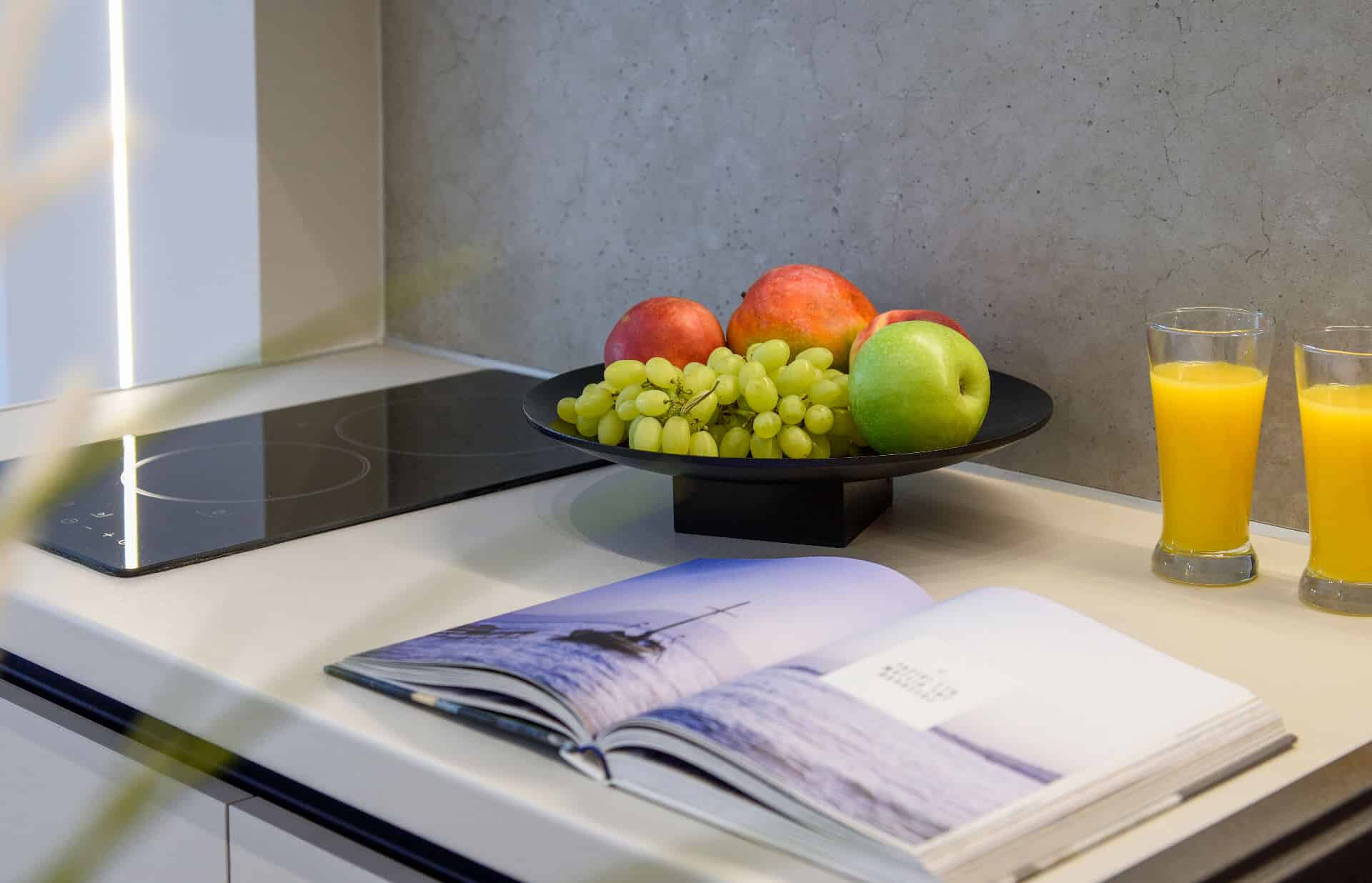
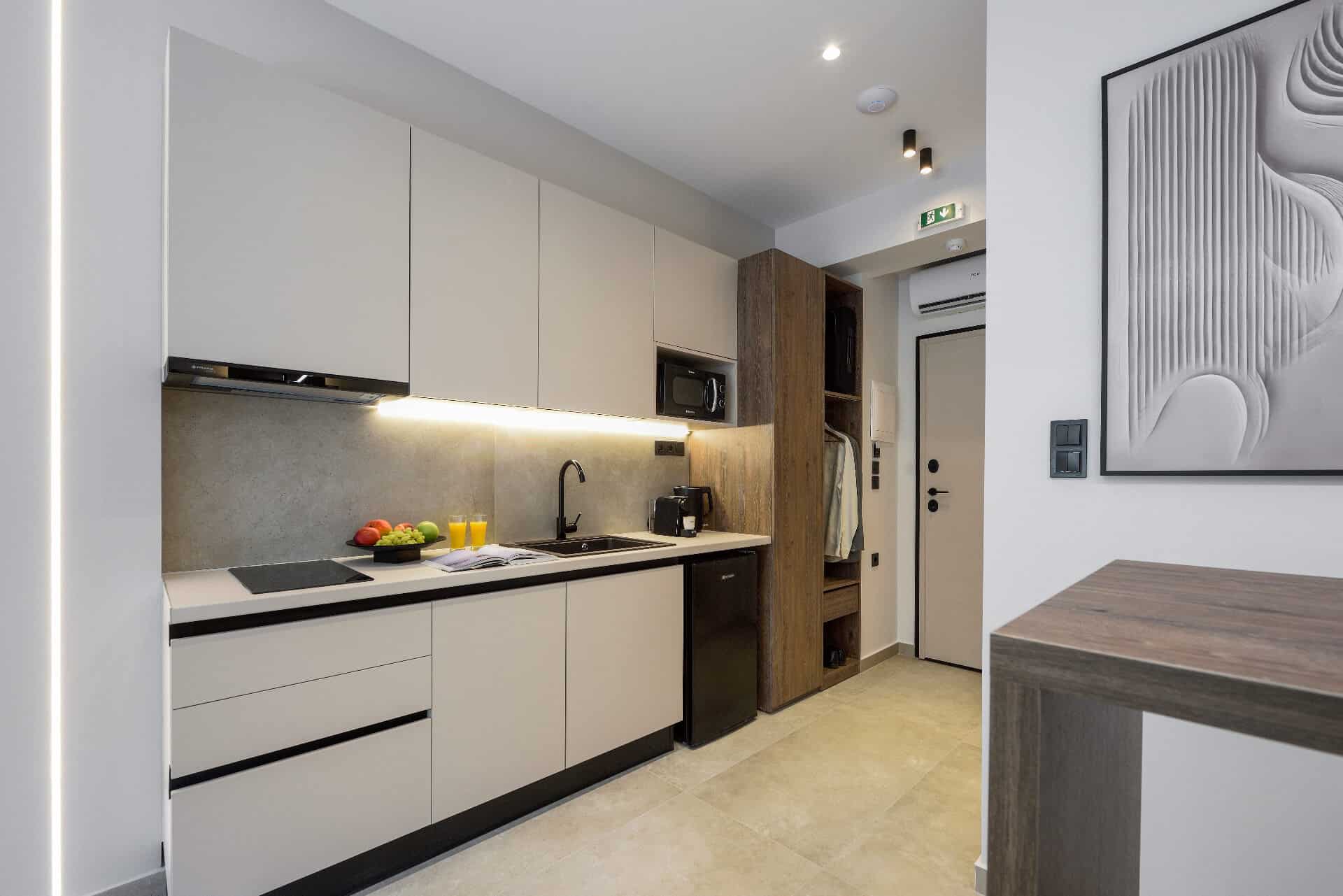
On the suite's kitchen counter — fruit and fresh orange juice.
Modiano: covered food hall under a glass roof
Kapani: open-air bazaar of fish, olives, and spices
Best earlier in the day, when stalls are fullest
Street food: bougatsa, koulouri, and gyros
Some of the best eating here costs little and happens standing up. Mornings belong to bougatsa, a flaky filo pastry filled with sweet semolina cream and dusted with sugar and cinnamon, or with cheese and minced meat for a savoury version. The maker the others call teacher is Bantis, hand-pulling its phyllo since 1969 in the Panagia Faneromeni quarter. Alongside it, the koulouri, a sesame bread ring sold from street carts, is the city's everyday snack. At any hour, gyros and souvlaki wrapped in pita are the reliable fallback — Savvikos has been the city's souvlaki name since 1947, with a store on the Ladadika edge, and Diagonios, a longer walk east, is the reference for Thessaloniki-style soutzoukakia. None of this needs planning or booking. A bougatsa and a strong coffee, eaten on a bench, is a genuinely Thessaloniki way to start the day.
Bougatsa: sweet cream or savoury cheese and meat
Koulouri: sesame bread rings from street carts
Gyros and souvlaki in pita, any time of day
Pies and sweets: trigona, pies, and a sweet tooth
Thessaloniki finishes meals as seriously as it starts them. The signature sweet is trigona panoramatos, crisp triangular pastry cones filled with cream — and the shop that made it is Elenidis, ranked #50 on TasteAtlas's 150 Most Legendary Dessert Places in the World, about ten minutes away on Tsimiski. For Constantinopolitan sweets there is Chatzis, founded in 1908 and one of the city's most historic patisseries, while Terkenlis — the name that taught Greece to eat filled tsoureki — has its flagship on Aristotelous. Beyond them, the city has a deep tradition of pites, both sweet and savoury. Save room: even after a long meze table, locals will steer you toward something sweet and a final coffee before the night is done.
Trigona panoramatos: cream-filled pastry cones
Savoury and sweet pites (pies)
Syrup pastries and spoon sweets from the Anatolian tradition
Coffee culture and the long sit
The city runs on coffee, and not the takeaway kind. Thessaloniki has one of the strongest cafe cultures in Greece, and a freddo espresso or freddo cappuccino, served tall over ice, can occupy an entire afternoon. On our own quarter, The Blue Cup is the shop credited with bringing specialty coffee to the city — single-origin by day, and behind no sign at all, a hidden speakeasy by night; a few doors on, Valenio roasts some of the most decorated coffee in town. The cafes along Aristotelous Square, about 9 minutes away, and the smaller spots in the lanes behind it, are made for sitting rather than rushing. Order one drink and stay for two hours; nobody will hurry you.
Beyond the city: regional flavours and day trips
The wider region feeds the table too. Central Macedonia is wine and produce country, and several celebrated foods and day trips sit within easy reach of a central base. Halkidiki, to the southeast, supplies much of the seafood and the green olives the city loves, alongside its beaches. North and west lie the royal Macedonian sites of Vergina and Pella, while Mount Olympus and the Edessa waterfalls make natural escapes. Each pairs a half-day of sightseeing with a long regional lunch. From a base in the centre you can taste the city by day and the countryside by short drive.
Where to base yourself for the food
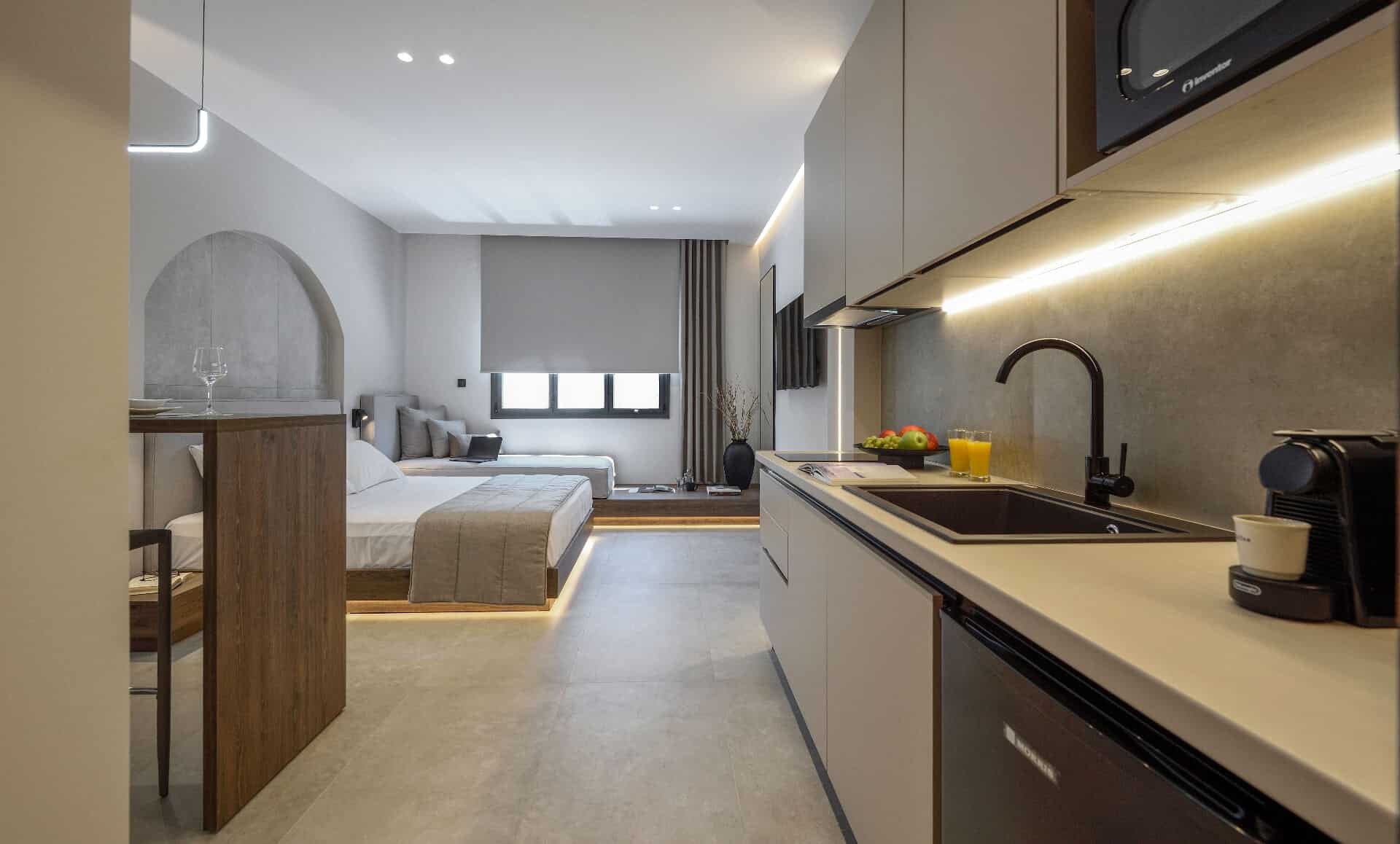
The simplest way to eat well here is to sleep in the middle of it. Loena Luxury Suites sits inside Ladadika, the old olive-oil quarter that is now the liveliest dining core, with the tavernas roughly 2 minutes away, the port and Modiano about 8, and Aristotelous and the markets about 9 — all on foot. Each of our five 30 m2 suites has a full kitchen for market hauls, plus self check-in from 15:00. Honestly, weekend nights the quarter is audible; light sleepers can ask us for the quietest available suite. Come hungry and walk everywhere.
Contemporary Cretan by chef Manolis Papoutsakis, Doxis 4 — carob threaded through the bread, pasta and pastries.
FNL 2-star 2026
Όλυμπος ΝάουσαOlympos Naoussa
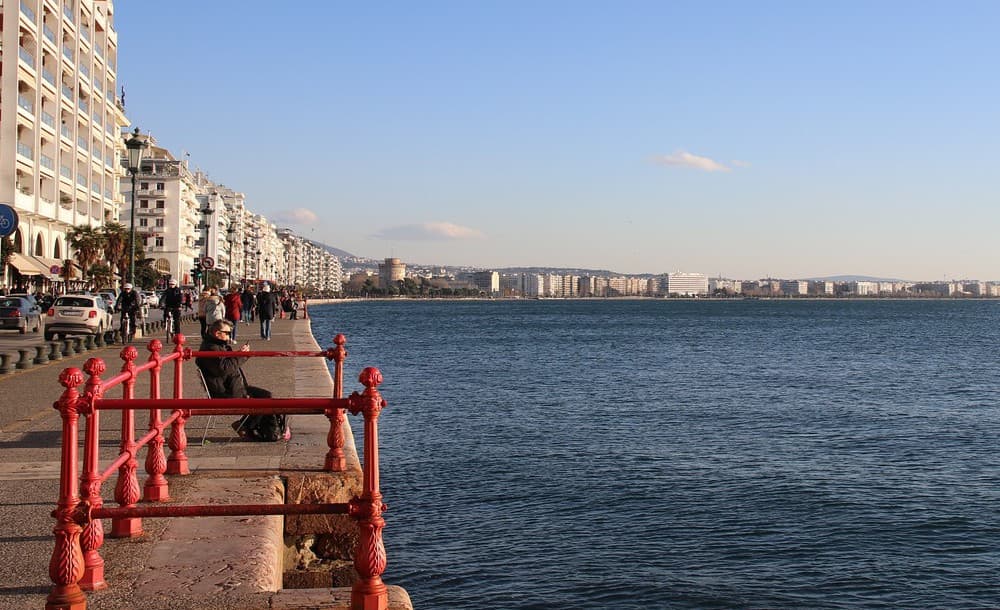
Nea Paralia — 8 min walk
Revival of the 1920s waterfront legend, inside a 1926 Jacques Mosse mansion at ON Residence, Leoforos Nikis 5.
FNL 1-star 2026, declared heritage monument 1993
Clochard
Aristotelous — 8 min walk
Contemporary Greek with French accents by chef Sotiris Mantzarakis, Komninon/Mitropoleos — over 40 years in the city.
FNL 1-star 2026, since 1979
Local
Roman & Byzantine city — 10 min walk
All-day bistro and city meeting point, small plates for sharing by chef Jake Jovanovic.
FNL 1-star 2026, 25-year institution
Διαγώνιος 1977
Roman & Byzantine city — 22 min walk
Reference grill-restaurant for soutzoukakia, Strat. Kallari 13, white tablecloths since May 1977.
Greek Gastronomy Guide, since May 1977
ΜούργαMourga
Roman & Byzantine city — 13 min walk
Modern fish-meze room with natural wine by chef Giannis Loukakis, Christopoulou 12.
The room that defined the city's modern style
Salonika
Greater Thessaloniki — 22 min walk, by taxi
Fine-dining with open kitchen and views over the Thermaic Gulf and Olympus, inside the Makedonia Palace (Leoforos Megalou Alexandrou).
FNL 2-star 2026, Chrysos Skoufos 2026, Greek Cuisine Award 2024
Marrone
Greater Thessaloniki — 20 min walk, by taxi
Contemporary chef-driven room in Kalamaria (Sofouli), by chef Konstantinos Slamvakis.
New FNL 1-star 2026
Το ΜανιτάριTo Manitari
Greater Thessaloniki — 20 min walk, by taxi
Modern bistro in Nea Krini, Kalamaria — creative, comfort-driven urban cooking.
New FNL 1-star 2026
Seafood
TRIZONI Exclusive
Ladadika — 3 min walk
Wild line-caught Greek fish, Doxis 1 and Salaminos — oakwood-charcoal grill, raw bar.
FNL 2-star fish 2025
7 Θάλασσες7 Thalasses
Aristotelous — 6 min walk
Central fish restaurant, Kalapothaki 8–10, fresh Mediterranean fish and a 300-label wine cellar.
Travelers' Choice, ~988 reviews
Ψαράς — Fisheria
Modiano & Kapani — 8 min walk
Working fishmonger with a small restaurant at Plateia Athonos — the city's fish dry-ageing pioneer.
Petros Semkos, fish dry-ageing pioneer
Μαύρη ΘάλασσαMavri Thalassa
Greater Thessaloniki — 20 min walk, by taxi
Centennial fish taverna since 1926 on the Aretsou-Kalamaria waterfront (Nik. Plastira 3) — a hundred years of operation, near-zero-intervention cooking.
FNL 2-star fish, since 1926, plain white taramas
Tavernas & meze
Ζύθος ΛαδάδικαZythos
Ladadika — 2 min walk
Greece's first registered beer hall (1990), in an 1902 neoclassical building, Katouni 5.
Since 1990, Politiki cuisine
Φουλ του ΜεζέFull tou Meze
Ladadika — 1 min walk
Ladadika's most-reviewed mezedopoleio, since 2008, Katouni 3.
Lesvos-style ouzeri in the old market off Ionos Dragoumi (Kapodistriou 5), since January 1991.
Eagles of Gastronomy
ΤσαρούχαςTsarouchas
Roman & Byzantine city — 12 min walk
24-hour patsatzidiko at Olympou 78 — legendary for the best patsas in Greece, founded 1952.
Since 1952, pot lit continuously since 1967
Στου Μήτσου
Modiano & Kapani — 7 min walk
Traditional kafeneio-mezedopoleio inside the Kapani market (Vlali 11) — hand-made mezedes from the market stalls.
Greek Gastronomy Guide, Kapani market since 2014
Street food
Τα Μπακαλιαράκια του Αρίστου
Ladadika — 2 min walk
Fried-cod-and-skordalia institution, founded c.1910, Katouni 3.
BBC-covered, Chrysi Etaireia
Δικάβαλο στο ΔερλικατέσενDikavalo
Aristotelous — 8 min walk
The city's most mythologised souvlaki, Kouskoura 3 — two whole pork souvlakia in a tortilla.
Cult status, evening-only
Sun Do Each
Roman & Byzantine city — 12 min walk
Cult sandwich shop at Plateia Ippodromiou 12 — signature "Mortadella Dreaming" and bread baked to order.
5.0 TripAdvisor
Frequently asked questions
What food is Thessaloniki famous for?
Thessaloniki is widely regarded as Greece's gastronomy capital, and a few things define it. Meze culture is central: rounds of small shared plates, especially seafood, eaten slowly with tsipouro or ouzo. Mornings mean bougatsa, a flaky filo pastry filled with sweet cream or cheese, and the koulouri sesame bread ring. Gyros and souvlaki are the everyday wrap. The signature sweet is trigona panoramatos, crisp pastry cones filled with cream. Underpinning all of it is an Anatolian and Balkan heritage and a serious coffee culture built around the long, unhurried sit.
Where are the main food markets, and how far are they from the suites?
The two historic markets sit close together just inland from Aristotelous Square. The restored, glass-roofed Modiano arcade now works as a covered food hall of mezedopoleia and small producers, while the neighbouring open-air Kapani is the older bazaar of fish, olives, spices, and cheese. From our suites in Ladadika they are roughly 9 minutes on foot. Both are best earlier in the day, when the stalls are fullest. Come hungry, browse without a plan, and let an early lunch happen at the counters.
Can I cook in the suite with what I buy at the market?
Yes. Each of our five suites has a full kitchen, so a haul of fish, olives, cheese, and produce from Kapani or Modiano can become a meal at home. There is a Nespresso machine for coffee, shared laundry access, Wi-Fi, and a smart TV. With the markets about 9 minutes away and tavernas roughly 2, most guests do both: a market breakfast or a cooked night in, and long meze dinners downstairs. Self check-in is from 15:00 and checkout is at 11:00; breakfast can be arranged on request for an extra cost.
Is Ladadika a good base for eating out, and is it noisy at night?
For food, it is hard to beat: the tavernas, tsipouradika, and bars of the old olive-oil quarter are right outside the door, with the port and Modiano about 8 minutes away and Aristotelous about 9. The trade-off is honest. Weekend nights the lanes stay lively and are audible from the suites, and we won't pretend otherwise. Soundproofing is improving, but if you are a light sleeper you can message us on WhatsApp and we will do our best to put you in the quietest available suite. Midweek is far calmer.